Guided setup for people and agents
RoomCall lets an authenticated Home Assistant administrator discover speakers,
review a persistent configuration plan, apply it, test audio, resume later, and
undo it. The card and roomcall__setup tool use the same backend. Ordinary message
tools keep their existing entity permissions and assistant exposure checks.
Start before a configuration exists
Install RoomCall from the Marketplace (HACS before HA 2026.11) first, and restart HA if asked. An agent needs HA's normal integration configuration capability to start a RoomCall user configuration flow:
POST /api/config/config_entries/flow
{"handler":"roomcall","show_advanced_options":false}
Opening that flow registers RoomCall's tools and card resources before an entry exists. It does not select speakers or enable optional services. An installed integration that has never been opened cannot register its own tools automatically. If the agent cannot start HA configuration flows, a person opens Add integration → RoomCall once. Installation and permissions remain managed by HA and its Marketplace or HACS.
On current HA, tools are contributed to HA's LLM platform. Older supported HA uses the selectable RoomCall LLM API. External clients use HA's configured MCP integration. The administrator identity must reach the tool's HA context; an anonymous automation context cannot administer setup.
Discover the contract
Call roomcall__catalog with {}. It returns API version 1.0, all available operations,
their input schemas and common response envelope, administration/read-only flags,
and the bootstrap recipe. HA's MCP bridge controls which native tool metadata it
forwards; RoomCall exposes response schemas inside this catalog, without assuming
the bridge forwards MCP outputSchema.
All operations also work through roomcall.communicate or authenticated
POST /api/roomcall/command with {"operation":"setup","request":{...}}.
Success and failure include ok and api_version. Errors include stable code,
translated message, retryable, details, and executable next_actions.
Setup sequence
These are request bodies for roomcall__setup:
| Action | Request and result |
|---|---|
| Discover | {"action":"discover"} returns endpoints, availability, eligibility, areas, deduplicated recommendations, permitted TTS providers, current settings, settings schema, and unresolved questions. |
| Plan | {"action":"plan","settings":{"speakers":["media_player.kitchen"],"tts_engine":"tts.piper","volume":0.35}} validates and saves a draft; returns its id, revision, settings, changes, and questions. No audio plays. |
| Apply | {"action":"apply","id":"PLAN","revision":"REVISION"} applies through HA's native config/options flow. Repeating an unchanged apply is safe. |
| Verify | {"action":"verify","id":"PLAN"} separates configuration readiness, provider readiness, endpoint availability, human audio confirmation, and overall completion. Follow its next_actions. |
| Test | {"action":"test","id":"PLAN","speaker":"media_player.kitchen"} plays the existing test sound and returns a job ID. Poll roomcall__status. |
| Confirm | {"action":"confirm","id":"PLAN","speaker":"media_player.kitchen","heard":true} records what a person reports. An agent must ask the person; it cannot infer this from a successful job. |
| Skip | {"action":"skip","id":"PLAN","speaker":"media_player.kitchen"} records a skipped, unverified speaker. It never supplies a listening confirmation. |
| Resume | {"action":"list"} lists the caller's active plans. {"action":"get","id":"PLAN"} retrieves one. |
| Undo | {"action":"undo","id":"PLAN","revision":"REVISION","confirm":true} restores the exact previous options or removes only the entry created by this plan. |
Only one available TTS provider can be selected automatically. With zero or
multiple providers, choose explicitly or set media_only:true when planning a
recorded-audio-only installation. Volume is optional. Nested settings patches
preserve unrelated saved values; null removes an optional override (HA's initial
entry value still applies if present, and is shown in the plan). Review
changes before applying, including defaults added by HA's schema.
Listening confirmations belong to the plan that issued the test. Confirming an
unrelated or older test does not verify a new setup. Retesting clears the previous
confirmation until a person answers again. Endpoint result values are heard,
not_heard, skipped, or untested; unsuccessful listening results include a
troubleshooting_url. Discovery and downloaded diagnostics expose the same saved
audio_verification, with configuration_current and audio_confirmed flags.
Plans belong to their creator, survive HA restarts, expire after 24 hours, and
carry configuration revisions. Intervening changes return configuration_conflict
instead of overwriting them. Interrupted apply/undo operations reconcile a native
commit on retry. Undo refuses to remove a new entry if announcements were added
afterward. Store capacity is 32 plans; expired, draft, or rolled-back plans may be
evicted. Undo does not undo previously delivered audio or unrelated HA changes.
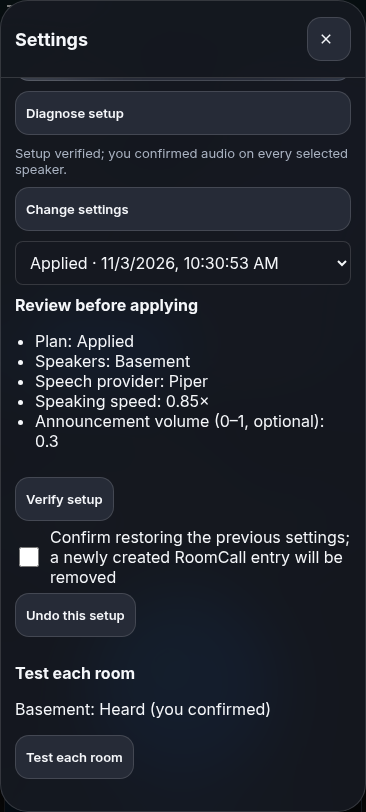
The card's Settings → Setup and sound tests → Guided setup provides discovery, speaker selection, speech provider, volume, review, apply, resume, sound tests, verification, and explicitly confirmed undo. It uses native controls and HA theme colors.
Receiver and TV routes
Discovery reports audio-URL eligibility separately from app/remote controls. Use
Cast for Android TV audio and paired Android TV Remote for supported wake/app
restoration. Check endpoint.interruption and catalog.playback_routes before
planning an explicit receiver/HDMI route under communication.playback_routes.
Controllers need their own HA permissions and assistant exposure. The shared setup
plan validates these settings without playing audio; review the recipient preview
and run a sound test after applying. Restoration observations are separate from
request acceptance and do not guarantee recovery of a provider-owned session.
See routes and limits.
Announcement administration
Use roomcall__announcements, restricted to authenticated administrators:
{"action":"schema"}retrieves scheduled and triggered field schemas.{"action":"create","kind":"scheduled","idempotency_key":"weekday-bus","values":{"name":"School bus","time":"07:30:00","days":["mon","tue","wed","thu","fri"],"message":"Bus in ten minutes","rooms":["kitchen"]}}creates through HA's native subentry flow.{"action":"list"}returns IDs, values, enabled state, and revisions.updatetakesid, currentrevision, and partialvalues.enableanddisabletakeidand currentrevisionand operate the native enabled switch.deletetakesid, currentrevision, and explicitconfirm:true.
Templates, targets, exposure, permissions and native field validation are checked before saving. Retry the same create with the same idempotency key to retrieve the same announcement. If it was subsequently edited, the retry returns its current values without overwriting them. Changed create payloads conflict; deleted announcements are not resurrected by retrying their retained key. Up to 128 idempotency records persist locally, with oldest-record eviction. This bounded history is not an indefinite guarantee after eviction.
Diagnose and recover
roomcall__doctor with {} reports unavailable/missing selected players, active
Do Not Disturb and quiet hours, human-reported silence, accepted requests without
matching playback reports, unavailable/ambiguous TTS, and suspicious media URLs.
Loopback, .local, and default Docker bridge findings link to HA Repairs; missing
URLs and general HTTPS guidance link to network settings. The URL repair proposes
a source IP from HA’s network integration and requires explicit human confirmation
before changing the shared internal URL. These checks do not prove speaker access.
An alternative route is proposed only when an available eligible entity shares a
registry device, stable MAC, verified manufacturer/model/serial identity, or explicitly
configured physical-speaker alias. Model
or room similarity is insufficient. To review one, call
{"action":"plan_route","speaker":"media_player.old","alternative":"media_player.alternate"}.
The returned setup plan must still be reviewed, applied, tested and verified.
Diagnosis never changes network settings, exposure, DND, urgency, cloud providers,
or retention automatically.
Acceptance measurements
CI exercises the native HA LLM tool API using deterministic protocol-agent journeys: fresh setup to explicit human confirmation, and interrupted apply/undo across stored state reload. Additional tests cover stale plans, denied permissions, diagnosis, physical route proposals, announcement CRUD, retries and native-flow failures. The CI summary reports tool calls, configuration questions, human listening confirmations, completion, recovery and documentation lookups per recorded journey. These are protocol tests with mocked devices/providers and scripted human answers, not an external language model benchmark or a physical-speaker certification.
Runtime diagnostics retain bounded local setup-completion counters/session timings and delivery observations by route. Device audio-fetch/playback latencies remain separate from acoustic first-audio latency, which stays unknown without a real measurement. Existing job idempotency/deduplication and evidence checks test against duplicate delivery and incorrect success reports. Unknown missed/heard messages remain unknown. Python statement coverage is gated at 100% for both supported HA test versions and the standalone package; browser QA checks narrow layouts, guided setup and consent-based WebRTC.